Wednesday, 17 January 2018

FURTHER GLIMPSES INTO AFRICAN LITERATURE


NEW BOOK:

Further Glimpses into African Literature

Edited by I. M. Soqaga (above) and O Bolaji

Publisher: Eselby Jnr Publications, Bloemfontein, South Africa..

First published, January, 2018.

Dedicated to the late Flaxman Qoopane

This book follows on the heels of the work, Glimpses into African Literature, edited by I M Soqaga, 2015. There are about 30 essays, book reviews, and/or profiles on African writers, et al in this new work. Essays here include those on Jagua Nana (Ekwensi), Houseboy (Oyono), Mine Boy (Peter Abrahams), Father of Letters (Qoopane), The Secret lives of Baba Segi’s wives (Shoneyin), Khanyi Mbau biography, Charles Mungoshi’s new book, The Man Died (Soyinka), July’s People (Nadine Gordimer), Efunsetan Aniwura, Leseli Mokhele, The poetry of Tiisetso Thiba, People of the Townships (Bolaji), Shehu Sanni, Memory Chirere, Ellen Banda-Aaku, Dillibe Onyeama, Vonani Bila, Maxwell Kanemanyanga, Richard Rive, Laureta Ngcobo, Elechi Amadi, Adebayo Faleti, Buchi Emecheta, Isidore Okpewho, Heidi Holland, Flaxman Qoopane, and Keorapetse Kgositsile.

‘This new work is a sequel to the book, Glimpses into African Literature (2015) which was edited by I.M. Soqaga. Here, a miscellany of essays and book reviews whisk us along into the literary work of dozens of Southern African, East African, and West African writers and poets.  
                                                                              
The last section of this work- IN MEMORIAM - is particularly poignant, focusing on a number of outstanding, now deceased writers; including Miriam Tlali, Lauretta Ngcobo, Buchi Emecheta, Flaxman Qoopane, Heidi Holland, and Keorapetse Kgositsile. This book is a must for all those interested in African Writing.’
From the blurb

Wednesday, 10 January 2018

ADIEU, BRA WILLIE!


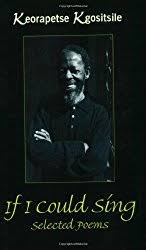
South Africa's greatest Black poets? On a personal note, my mind always automatically goes to Mongane Wally Serote, and Keorapetse Kgositsile, who died in early 2018.


I have been lucky enough to meet both exalted bards over the years. Kgositsile epitomized poetry and was a warm, affable, eclectic  presence who graced poetic and literary occasions with elan.


 Prof Kgositsile (aka 'BraWillie') always exuded bonhomie despite his awesome credentials as international academic, wordsmith and author of several works distributed in hundreds of literary centres worldwide.  He would very warmly hold hands with much younger burgeoning poets, joking with them, showing them many of his published works in deprecating fashion.

His face always creased with smiles; evoking laughter and applause, Bra Willie was nevertheless a tough literary critic who would attack the works of the literary greats like Achebe and Ngugi. But of course in fairness to him, he was critical of his own works too. "One might find out that what one has written is a can of worms" he would say.


He was a well travelled, polished bard, highly respected globally.  I recollect Mr Malcolm Hacksley, former Director of NELM Grahamstown telling me some intriguing anecdotes about Bra Willie. The late Flaxman Qoopabe was also well enamoured with prof Kgositsile. His pungent criticism often upset much younger bards at literary occasions, but nevertheless they all warmed to him and admired him.


The late prof Kgositsile early in his career was something of a journalist; he went on to study at Columbia University in the USA, where he was influenced by Black poetry, with strong musical - jazz - elements integral to his poetry. He published over ten revered works on poetry, and was named as South African National Poet Laureate in 2006.
-         O Bolaji

Wednesday, 20 December 2017

THE TWISTED THING. By Mickey Spillane


I have read a few Mickey Spillane works, and what hits one most, quite frightening, is the violence in the books. It is often more than gratuitous, brutal. Tremendous ruthless battles and fights, blood spilling out from guts and nerves and from pretty much everywhere. It is no different here, the brutality of the fights involving Mike Hammer. If he is not a sadist, then one wonders what a sadist is!

Yet this novel, the story is quite good and i daresay convincing. The psychology behind the trend of events, the flow, the "twisted" youngster himself is quite spot on. Do we at the end feel pity for the boy genius?

 I like the undulations of the way he (the boy genius) has fallen for the lady in question here, though she is much older and would regard him as a child. But psychologically and emotionally he is no kid. He is very intelligent cerebral and calculating. Which all adds to the pathos of this hard-hitting story, I suppose.
-         - Henry Ozogula

Thursday, 23 November 2017

FLAXMAN QOOPANE (1955 - 2017)


By O Bolaji

Flaxman Moalusi Jacob Qoopane, who has just died, always had a palpable ambience of joie de vivre around him - and his extraordinary love for books, authors, literature, and libraries nourished this patina of exaltation.


Qoopane for decades had an astonishing career as a colourful, enterprising journalist, columnist, poet and author of several works. His shorter works were published in dozens of newspapers, magazines, journals and general books.

It is no surprise that news of his passing continues to shock the world, with the literary fraternity rocked and devastated. Ishmael Mzwandile Soqaga, the well known literary critic reacted spontaneously: "So Flaxman has departed this world?  I am crying now with poignant sorrow...he certainly played his part. Africa must celebrate this important literary figure,"


Charmaine Kolwane Mrwebi, the avant-garde poet, literary activist and publisher, was more philosophical. "Our Literary Father is Resting, Father  of Letters...We are Praying for his Family" she said.

Nthabiseng Jah Rose Jafta, fecund poet and Creative Writing Mentor/Facilitator, said: "It is really sad. Ntate Qoopane was there for us since we were very young. We remain eternally grateful,"

Raphael Mokoena, another literary critic, averred: "Qoopane contributed prodigiously to African writing in particular. He unearthed, introduced, wrote about countless writers and poets over the years. He was a celebrated poet. He published many books of different genres: biographies, essays, criticism, general profiles, and epistolary"


Indeed, many of Qoopane's published books have been internationally digitised by lofty universities/literary centres. Flaxman also orchestrated the Qoopane Literary Gallery whose magnificent contents should now be taken over and preserved  by the powers that be, as part of his sterling legacy.

Two years ago, Qoopane turned 60, and as part of the events marking the occasion, Charmaine Kolwane put together a book of essays, poems, articles, critiques etc all celebrating the remarkable Flaxman Qoopane (FATHER OF LETTERS).  Literary pundits are now calling for the book to be stocked in every conceivable library. "Our people - new generations - must read about this man whose life celebrated books and literacy" a tearful Soqaga stressed.

Books published by Flaxman Qoopane

A Poet Abroad
Memoirs of a Cultural Activist
Adventures in Journalism
Reneiloe-Mpho's story
Macufe 2001
Women of Talent
Gilbert Modise: the man and the myth
View from my Window
Omoseye Bolaji: Perspectives on his literary work
The Conference
THE CREST
City of Roses and Literary Icons
Scintillating stars from the vibrant soil

Wednesday, 22 November 2017

THE VILLAGE IN THE JUNGLE. By Leonard Woolf


Memorable books continue to be celebrated through the decades and even over the centuries...Shakespeare's work is a case in point here. In Africa although Chinua Achebe published his classic, Things fall apart almost 60 years ago, the novel still remains the most popular and saluted ever in the continent. Leonard Woolf - alas, one has to add here for the sake of many that this great writer in his own right was Virginia Woolf's husband - wrote the work, The village in the jungle, over 100 years ago, and till date many literary experts worldwide still consider the novel to be very important, a work focusing on an erstwhile colonised third world country so to speak.

It is often posited that Mr Woolf in the work, very unusually for the time dealt with the pertinent denizens of the struggling area with sympathy and somewhat criticised the powers that be who were ruling the country. It is also conceded that the book has a lot of literary merit. And so it does.

This work is set in the former British colony of Ceylon (now Sri Lanka). It focuses on a particular village, its activities; and essentially on one family which has Silindu as the Father. His daughters, Hinnihami and Punchi Menika are key characters too, as is Babun, the husband of Punchi. There is the notorious ‘headman’ of the village, Babehami, and Fernando, the debt collector who wants Punchi as a mistress. The headman (with Fernando in tow) manages to get Silindu and Babun arrested and tried by the colonial authorities. Babun is incarcerated, whilst an incandescent Silindu shoots Babehami and Fernando. The law has to deal with Silindu, who has become a
double-murderer.

In this remarkable story, we see how the life of the village(ers) is anchored on ‘chenas’. As the author explains, ‘The life of the village and of every man in it depended upon the cultivation of chenas. A chena is merely a piece of jungle, which every ten years is cleared of trees and undergrowth and sown with grain broadcast and with vegetables. The villagers owned no jungle themselves; it belonged to the Crown, and no one might fell a tree or clear a chena in it without a permit from the government…’

The stultifying, even frightening impact of the jungle on the village is distinctly emphasized throughout this novel. ‘The Jungle surrounded it, overhung it continually pressed in upon it. It stood at the door of the houses, always ready to press in upon the compounds and open spaces, to break through the mud huts, and to choke up the tracks and paths…’

- O Bolaji